Media
State Media avoids reporting on Workers’ Party’s ‘Hougang: The Documentary’
The Workers’ Party’s Hougang: The Documentary has nearly 60,000 YouTube views, but state-linked media like CNA and The Straits Times have yet to report on it on their online news sites. Lianhe Zaobao’s brief mention adds to concerns about selective coverage of opposition stories in Singapore.


As of 11am today, 后港 Hougang: The Documentary, released by the Workers’ Party (WP) in celebration of its 67th anniversary, has garnered nearly 60,000 views on YouTube.
The 1-hour-20-minute film presents Hougang’s rich historical, cultural, and political fabric and has sparked widespread public interest.
However, prominent state-linked media outlets, including Channel News Asia (CNA) and The Straits Times, have yet to cover the release a day after its debut, drawing attention to the issue of media impartiality in Singapore.
The Straits Times, part of SPH Media, a government-funded group, has remained silent on the documentary’s release, while CNA, owned by Mediacorp — which is under the oversight of Temasek Holdings, Singapore’s sovereign wealth fund — mentioned the documentary during its live news broadcast but did not include it in its online news report.
This absence can be seen as indicative of editorial selectivity when it comes to reporting on opposition-related content.
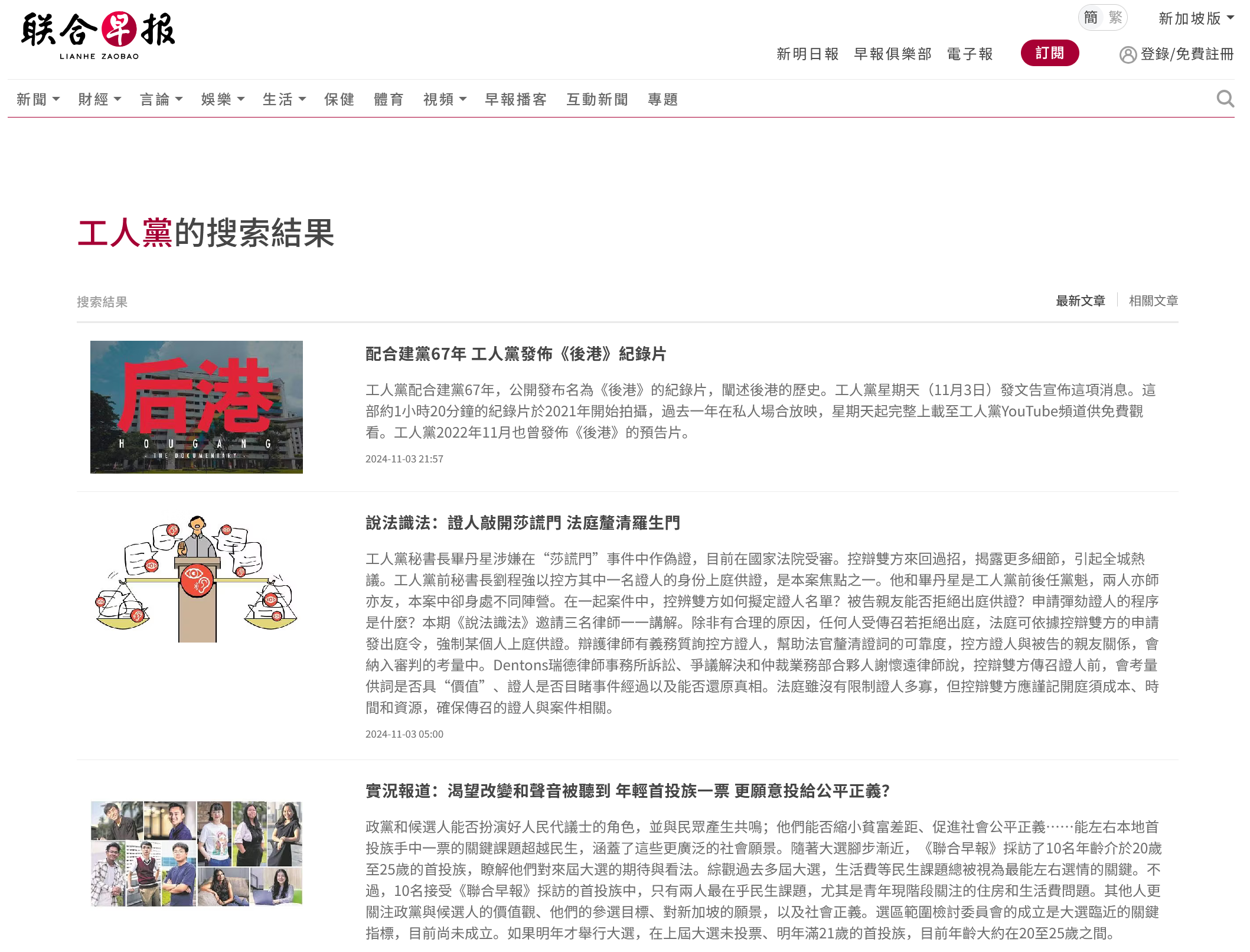
While Lianhe Zaobao, another SPH Media publication, made a brief post on Sunday night, it provided only minimal details, adding to the perception of a restrained approach.
The documentary provides an in-depth exploration of Hougang’s journey from its early 18th-century roots as a settlement for Teochew immigrants from Guangdong Province, who first resided on Pulau Ubin, to its establishment as a unique community.
The film underscores Hougang’s transformation from an agricultural and fishing hub to a significant political symbol under the WP’s leadership, particularly following its 1991 electoral win by former Secretary General Low Thia Khiang.
The WP’s victories in Hougang set the stage for their success in winning Aljunied GRC in 2011 and Sengkang GRC in 2020, achievements that further illustrate the party’s growth despite challenges posed by Singapore’s political environment, dominated by the ruling People’s Action Party (PAP).
The lack of coverage by CNA and The Straits Times comes amid ongoing discussions about the role and impartiality of state-affiliated media.
This discourse was notably brought to the fore in February 2022 during a Parliament session in which Members of Parliament raised questions about the disbursement of funds and the conditions attached to the significant government funding programme.
The government announced a budget of up to S$900 million to be disbursed over five years to support the media group, with about S$320 million has already been provided over the 2022 and 2023 financial years, with S$260 million budgeted for 2024
Leader of the Opposition MP Pritam Singh (WP-Aljunied), who is also the current Secretary-General of the Workers’ Party, then questioned the impartiality of media outlets in light of government funding.
Mr Singh asked how the government would reassure Singaporeans that “SMT’s content will not be tainted by allegations of political interference.”
In response, Minister Josephine Teo outlined that the funding could reach up to S$180 million annually, contingent on the media company’s investments and MCI’s evaluation of their outcomes.
She remarked that Mr Singh’s question appeared “too predictable” and seemed to imply a mistrust of the objectivity of mainstream media journalists.
“His question seems to suggest that he does not trust the journalists in our mainstream media to be objective in reporting, to apply their minds and to be discerning, or to have a sense of responsibility with truthful reporting for the public,” said Mrs Teo.
She added that, ultimately, the public’s trust in the media and their daily choices in news consumption would serve as the true test of credibility.
“And fortunately for us, for all of us, our local mainstream media are trusted by people and we have every reason to keep it so,” she concluded.
Despite such assurances, the absence of significant coverage on WP’s well-received documentary contrasts sharply with the growing attention it has received from the public, fuelling debates about how Singapore’s state-linked media manage political content.
To some observers, the silence tells a different story, calling into question the extent of the media’s editorial freedom in reporting diverse perspectives.
Edit: The previous version of this piece noted that CNA was silent on the documentary; however, we have since been informed that CNA did cover the documentary in a news report during its live broadcast.