Business
Ex-banker voices concerns over REITs dominance in STI, calls for diversification
Ex-banker Chris Kuan highlights worries over the STI’s REIT dominance, contends that Singapore faces challenges in fostering substantial local companies or attracting listings beyond the real estate sector.

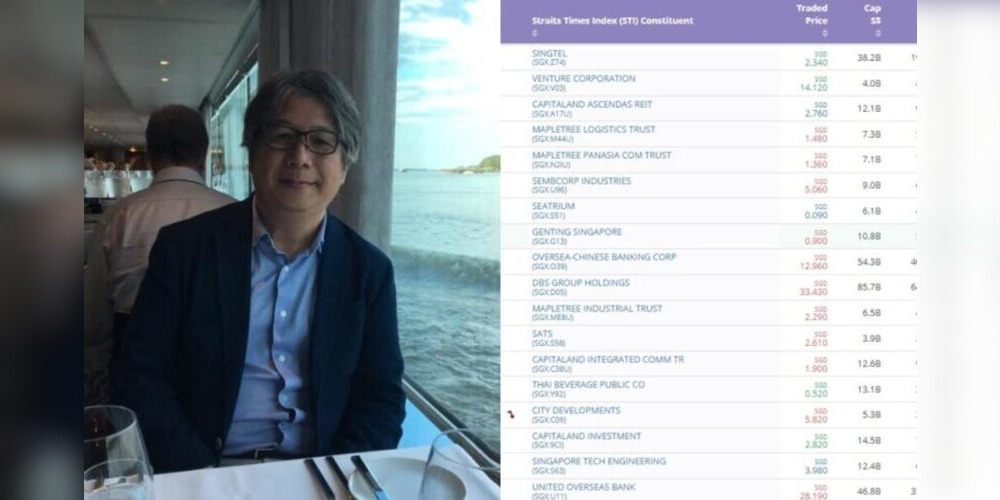
Former banker Chris Kuan has expressed concerns about the excessive presence of Real Estate Investment Trusts (REITs) in the Straits Times Index (STI).
The substantial concentration of the index within a single sector, particularly one reliant on rent-based revenues, raises concerns for Kuan, who perceives this as a less favourable indicator.
To address this issue, he recommends that SGX, banks, and asset managers explore the possibility of diversifying the range of investment trusts beyond REITs.
DollarsAndSense’s insights into STI “reserve list”
Singapore’s benchmark stock market index, the STI, comprises 30 companies, encompassing familiar names for many Singaporeans.
This includes the national flag carrier, the three local banks (DBS, OCBC, and UOB), Singapore Airlines, SingTel, property company CapitaLand Investment, engineering conglomerate Singapore Technologies Engineering, and more.
On Sunday (25 February), DollarsAndSense, a regional digital publisher providing insights on market information and financial matters, published an article discussing the five stocks on the STI’s “reserve list.”
The article suggested that these stocks have the potential to replace any of the existing 30 STI companies if they become ineligible.
As of December 2023, the reserve list includes:
- CapitaLand Ascott Trust (SGX: HMN)
- Frasers Centrepoint Trust (SGX: J69U)
- Golden Agri-Resources (SGX: E5H)
- Keppel DC REIT (SGX: AJBU)
- Suntec REIT (SGX: T82U)
“STI is already REIT-heavy”
Chris Kuan, a retired banker currently based in Japan, expressed concerns about the composition of the “reserve list.”
Notably, he pointed out that four out of the five stocks are Real Estate Investment Trusts (REITs).
He noted that the STI is already REIT-heavy, and having a significant portion of the index in a single sector, especially one generating rent-based revenues, is not a positive sign.
This concentration of real estate companies within the STI, including CapitaLandInvest, CapLand Ascendas REIT, CapLand IntCom T, CityDev, Frasers L&C Tr, HongkongLand USD, UOL, Mapletree PanAsia Com Tr, Mapletree Log Tr, Mapletree Ind Tr.
Mr Kuan pointed out that the overrepresentation of real estate companies in the STI highlights a fundamental issue with SGX.
He argued that Singapore struggles to produce large local companies or attract listings beyond real estate firms.
This lack of diversification may pose challenges to the overall health of the stock market.
“Singapore is unable to produce big enough local companies or attract listings other than real estate companies because other than the 5 REITS, there are also 4 other real estate companies., i.e. 9 out of 30 from a single sector that is generating basically rent-based revenues. ”
Mr Kuan also suggested that the government is playing a significant role in the situation by heavily relying on capital receipts from land sales.
“Overall it is a bad look for any stock market whose market cap comprises so much real estate. ”
Mr Kuan partly attributed the issue to the preferences of Singaporean investors, particularly their inclination toward dividend-yielding stocks.
This preference contributes to the dominance of Real Estate Investment Trusts (REITs) in the market.
He suggested that SGX, banks, and asset managers should consider broadening the range of investment trusts beyond REITs.
He recommended exploring trusts in renewable energy generation, infrastructure, debt, and equity, holding assets in Asia and/or globally distributing net income, similar to REITs.
Mr Kuan criticized SGX for not adequately diversifying the investment trust universe and, instead, opting for “fashionable shot in the dark” ventures like Special Purpose Acquisition Companies (SPACs), which he suggests did not end well.