Singapore
Assessing Singapore’s public transport payment system with other countries
In comparison to public transport card systems implemented in other countries, Singapore, despite its longstanding commitment to becoming a “Smart Nation,” appears hesitant to enhance convenience for its commuters.

Singapore’s Land Transport Authority (LTA) is currently facing criticism following its recent announcement about changes to public transport payment methods, excluding older cards by June 2024.
Last Tuesday (9 Jan), LTA announced that, effective 1 June 2024, older EZ-Link cards without the SimplyGo logo and Nets FlashPay cards will no longer be accepted as valid payment methods.
Netizens have pointed out significant shortcomings in SimplyGo, such as its inability to provide transaction details to commuters on buses or the MRT.
The online community questions why the previous system was able to offer this feature and expresses concerns about LTA’s lack of initiatives to address and improve the situation before removing the existing system.
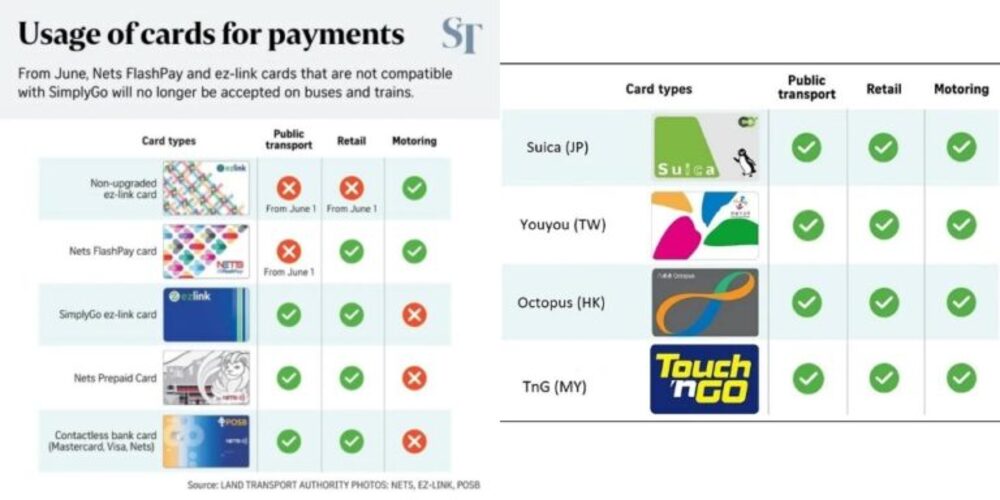
An infographic by Singapore’s state media, The Straits Times, outlined the functionalities available for each card type, such as non-upgraded EZ-Link cards or cards with SimplyGo, Nets prepaid cards, and contactless bank cards.
It appears that certain cards can only be used for specific purposes. For example, the SimplyGo EZ-Link card is usable for fare payment on public transport and at retail merchants accepting account-based EZ-Link card payments. However, it cannot be used to pay for ERP and car park charges.
Starting from June 1 this year, Nets FlashPay cards will no longer be accepted for public transport, but they will continue to be used for retail and motoring charge payments.
While contactless credit or debit cards can be used at MRT fare gates or card readers on buses, their usage is limited for motoring payments.
SimplyGo, being a stored card that cannot display fare cost and balance, is not applicable for motoring payments.
This situation is deemed unacceptable by certain commuters, as it is inconvenient for them to pay another deposit, have an additional card with cash value inside (which might expire), and risk losing money if not changed in time.

Source: ST’s Instagram
Card systems in other countries appear to have more extensive range of applications
Previously, suggestions within the online community have surfaced, proposing that Singapore should explore adopting a system similar to countries like Japan (Suica), Hong Kong (Octopus Card), and Taiwan (Youyou) by implementing a unified standard card for all transportation, convenience store transactions, and payments.
In contrast, these universal cards in other countries appear to have a more extensive range of applications.
For example, Suica, a prepaid e-money card issued by JR East Railways in Japan, goes beyond just paying for JR East trains and other public transport. It can be utilized for various transactions, expanding its functionality.
Taiwan’s EasyCard, commonly known as “Youyou (悠游卡),” is the island’s most popular and widely used reloadable smart card for both locals and travellers. It serves not only as a payment method for public transport but also extends to renting shared bikes.
Moreover, users can make payments at retail stores, entrance fees at tourist spots, and even at hospitals or clinics.
Similarly, Hong Kong’s Octopus card is versatile, being applicable on various transport services such as railways, buses, minibuses, coaches, ferries, car parks, and parking meters.
It extends its reach to over 180,000 acceptance points, including McDonald’s, 7-11, cinemas, grocery stores, and vending machines.
Singapore’s neighbouring country Malaysia has long embraced Touch ‘n Go for contactless payments.
Introduced in 1997, this smart card evolved from its initial purpose of making toll payments to a more extensive range of applications. Today, Touch ‘n Go is widely utilized for making payments not only in retail stores but also for convenient and seamless transactions on public transport.

Question on LTA’s possibly reluctance to enhance convenience for its commuters
In comparison to smart card systems implemented in other countries, Singapore, despite its longstanding commitment to becoming a “Smart Nation,” appears hesitant to enhance convenience for its commuters.
In a Tuesday press release explaining the decision to phase out older cards, LTA cited the growing adoption of SimplyGo payment methods.
“With the growing adoption of SimplyGo payment methods, and the legacy card-based ticketing system for adult commuters nearing the end of its operational lifespan, we are therefore transitioning all adult commuters to the SimplyGo platform by 1 June 2024,” said LTA.
Responding to concerns about fare information display with SimplyGo, LTA clarified last Friday that tapping a SimplyGo EZ-Link card would take “a few seconds” to retrieve and display balance and deduction information from the backend system.
“While this is technically possible, it will slow down the entry and exit for commuters,” said LTA.
“Given the large numbers of commuters who are taking MRT and buses, this will lead to longer queues which is not desirable.”
A notable concern voiced by many is the absence of a card balance display at MRT fare gates or bus card readers under the SimplyGo system.
Instead, the screen only shows “SimplyGo,” requiring users to check their card balance through ticketing machines or the SimplyGo app.
LTA defended this approach, stating that the SimplyGo app was designed to provide comprehensive trip details and alerts on fares through push notifications.
Users who opt not to use the app can access trip details and card balance information at ticketing machines in train stations and bus interchanges.
The technical language used by LTA to justify the discontinuation of the old card-based ticketing (CBT) system has left commuters perplexed.
Skepticism has been raised, with some arguing that if EZ-Link can display the balance immediately, then SimplyGo should be capable of the same functionality.
This article was first published on Gutzy Asia.