Politics
Former PAP Minister Tharman against two-step GST hike in 2007 to thwart price inflation
In 2022, Finance Minister Lawrence Wong announced a two-step GST hike from 7% to 9%, despite a 2007 report showing former Minister Tharman opposed such a move due to inflation concerns. The hike has since heightened living costs for many Singaporeans.

On 18 February 2022, during the budget speech, Finance Minister Lawrence Wong announced the goods and services tax (GST) rate to increase from 7 to 9 per cent in two stages, with one percentage point implemented on 1 January 2023, followed by another on 1 January 2024.
At the time, Mr Wong who is also the Deputy Prime Minister justified the GST hike by highlighting its expected contribution, estimating approximately 0.7 per cent of gross domestic product in annual revenue, which amounts to about S$3.5 billion when the full hike takes effect in 2024.
The increased revenue is earmarked for bolstering healthcare expenditures and providing support for senior citizens, alongside enhancing other areas of social spending.
Regarding the timing of the GST adjustment, Mr Wong acknowledged his careful consideration of various factors, including the ongoing pandemic, economic conditions, and the inflation outlook.
“Our revenue needs are pressing. But I also understand the concerns that Singaporeans have about the GST increase taking place at the same time as rising prices,” he said.
Singapore initially unveiled plans for a 2-percentage point GST increase from 7 per cent to 9 per cent back in 2018. However, this plan was delayed due to the Covid-19 pandemic.
Addressing worries that businesses might exploit the GST hike to raise prices, Mr Wong announced the establishment of the Committee Against Profiteering, chaired by Minister of State for Trade and Industry Low Yen Ling.
Mr Wong unveiled the Enhanced Assurance Package, comprising seven components designed to provide financial support to Singaporeans over the upcoming five years, as measures to offset the impact of the GST hike.
Mr Wong highlighted that, for the majority of Singaporean households, the package’s offsets would sufficiently address approximately five years of additional GST expenses.
Notably, for lower-income households expected to receive higher payouts, these offsets are projected to cover about a decade’s worth of additional expenses caused by the GST increase.
The package encompassed various forms of support, including cash payouts, augmented U-Save rebates tailored for utilities, and MediSave top-ups, among other measures aimed at alleviating the financial burden caused by the GST adjustment.
This two-tiered hike was approved by the PAP Members of Parliament in the Budget 2022, despite objections from opposition parties, the WP and the Progress Singapore Party (PSP). They cited the potential impact on the population.
Tharman in 2007: single-step rise in the GST to prevent profiteering by raising prices in anticipation of a second step
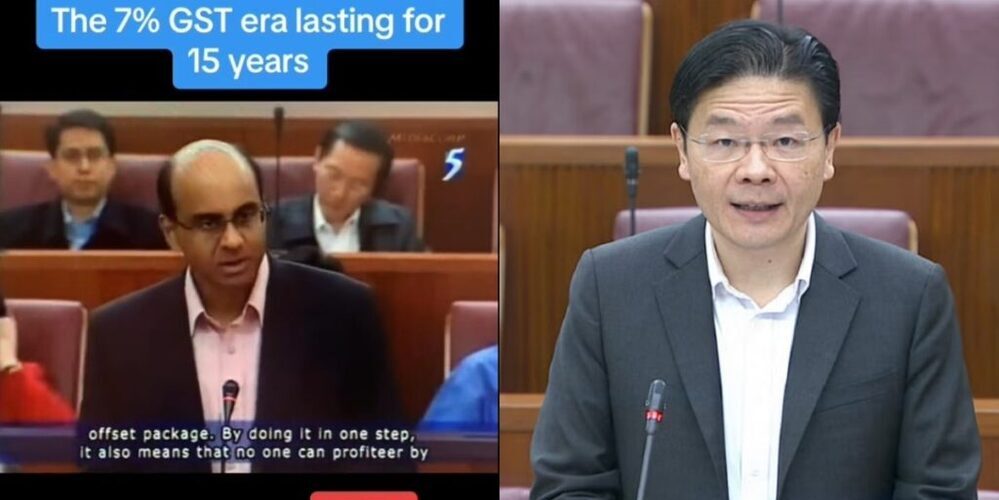
Recently, the social media platform Wake Up Singapore shared an archived news report dating back to 2007 that sheds light on then-Finance Minister Mr Tharman Shanmugaratnam’s perspective on a gradual GST increase.
It seems Mr Tharman at the time, who is currently elected ninth President of Singapore, had a different approach contradicting with current Finance Minister’s two-stage GST hike.
During the GST hike in 2007, Tharman articulated the rationale behind the 2-percentage point increase from 5% to 7%.
In his parliamentary address ON 15 February 2007, he advocated for a single-step rise in the GST, emphasizing the benefits of elevating prices in one go while compensating Singaporeans with a substantial offset package.
“By doing it in one step, it also means that no one can profiteer by raising prices in anticipation of a second step.”
Moreover, consolidating the increase into one step would save costs for businesses as they would not need to adjust their systems twice, he said.
The news video went on to detail the impact of the 2 per cent increase on prices at that time. For instance, it highlighted that a loaf of bread would cost 3 cents more, a cellphone about S$12 more, and a plasma TV approximately S$50 more.
At the time, Mr Tharman also announced measures to offset the GST increase, which cost the Government S$4 billion in total over five years.
Prior to the 2007 hike, the GST rate was also increased via a two-step hike from 3% to 4% on 1 January 2003 and to 5% on 1 January 2004.
PAP Ministers defended the necessity of the GST hike amidst Singaporeans felt the inflation pressure
As Mr Wong pursued a two-step GST increase, many Singaporeans began feeling the weight of inflationary pressures and the escalating expenses of daily necessities, significantly affecting the overall cost of living for a majority of the population.
An issued report from The Ministry of Manpower (MOM) in November 2023 highlighted the substantial impact of high inflation on the purchasing power of Singapore residents.
This resulted in a notable 3% decline in real incomes for resident workers positioned at the 20th percentile, in comparison to the previous year.
Even for median wage earners, despite a nominal wage increase, there was a discernible decline of 2.3% in their real incomes.
In August 2023, Mr Wong during a parliament session again dismissed the idea of deferring the GST increase despite a surge in Corporate Income Tax (CIT) revenue.
He asserted that such a move would only “store up more problems for the future”, leaving Singapore with fewer resources to address its growing fiscal needs.
Mr Wong further pointed out that growth in corporate income tax revenue is typically aligned with Gross Domestic Product (GDP) growth.
He clarified that any changes to the tax policies take into consideration not just year-to-year fluctuations but also medium-term trends in expenditures and revenues.
With the pressures of an ageing population and escalating healthcare costs, government expenditure is anticipated to increase from the current 18% of GDP to potentially over 20% by FY2030.
Arguing against the disadvantages of rising the GST — particularly in the time of growing inflation— WP MPs and PSP NCMPs proposed alternative revenue sources and also suggested dipping further into reserve earnings—a move that, while slowing reserve growth, will still not touch the principal sum.
Contrary to the PAP’s allegations, these plans do not constitute “raiding the reserves.”
The GST hike has ignited significant discontent among Singaporeans due to its cascading effect on inflation, causing dissatisfaction with the Singapore Government and the ruling party.
This article was first published on Gutzy Asia.