Parliament
DPM Wong flags challenges in tracking wealth Inequality in Singapore
Deputy PM Lawrence Wong highlighted the challenges in accurately assessing wealth inequality, citing the diverse nature of assets and the complexities surrounding the valuation process, and instead emphasized the government’s proactive use of wealth taxes like stamp duties and property tax to address the issue.

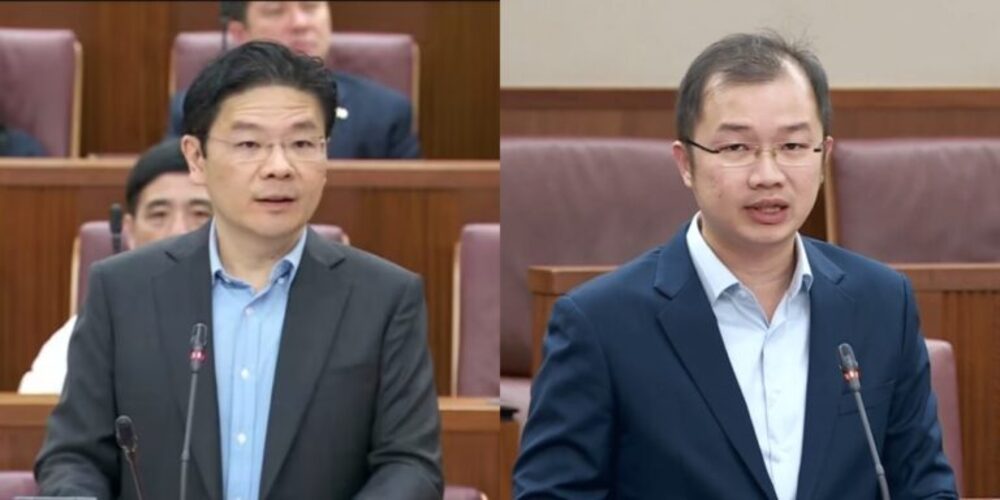
SINGAPORE: Lawrence Wong, the Deputy Prime Minister and Minister for Finance acknowledged that the Singaporean government faces limitations in its ability to precisely gauge wealth inequality.
However, this has not hindered the implementation of progressive measures aimed at addressing this concern, including leveraged wealth taxes, such as stamp duties, property tax, and the Additional Registration Fee (ARF) for motor vehicles, to mitigate wealth disparity, he said.
Mr Wong was responding to a Parliamentary Question filed by Mr Louis Chua, Workers’ Party MP for Sengkang GRC on Tuesday (7 Nov).
Mr Chua asked DPM Wong whether the Singapore Government tracks wealth inequality in Singapore; if so, what indicators are used to track wealth inequality; and whether there is data on these indicators over the last ten years.
In a written reply, Mr Wong shed light on the complexities involved in accurately measuring and monitoring wealth disparity in the country.
“Wealth is difficult to track comprehensively as it takes many different forms, including assets that are not publicly traded and thus, difficult to value. ”
“In addition, financial wealth is highly mobile across borders, and bank deposit data is protected by the Banking Secrecy Act. ”
“For these reasons, the Government is not able to measure and track wealth inequality accurately, ” he said.
Nevertheless, he said the government have been proactively putting measures in place to address wealth inequality.
He emphasized that over the years, the government has consistently fine-tuned wealth taxes, such as stamp duties, property tax, and the ARF for motor vehicles, to adopt a more progressive approach.
Recent revisions in Budgets 2022 and 2023 include heightened Buyer’s Stamp Duty rates for high-value properties and increased property tax rates for both non-owner-occupied and higher-value owner-occupied residential properties.
Additionally, the ARF for luxury vehicles has also been raised, signalling the government’s commitment to promoting a more equitable distribution of wealth.
Mr Wong noted that beyond these fiscal measures, the government has focused on fostering an environment conducive to wealth accumulation for all Singaporeans.
“We invest in and support Singaporeans in the essential areas of education, jobs, housing, and retirement, to help them secure good jobs and accumulate wealth over their lifetime. ”
“For instance, our CPF system enables Singaporeans to grow their savings, with higher interest rates for lower balances and additional government support to the lower-income, through schemes like Workfare and the Matched Retirement Savings Scheme. ”
He added that Housing subsidies have also been instrumental in providing robust assistance to less affluent segments of society in their quest for homeownership.
” Our investments and support in these areas position all Singaporeans to be part of the country’s growth, regardless of their backgrounds, with more support for those with less, ” Mr Wong concluded.
DPM Wong acknowledges challenges in incorporating non-work income in Singapore’s Gini Coefficient calculation
Separately, Mr Chua also sought clarification from the Minister of Finance on Singapore’s Gini coefficient over the past decade, encompassing both pre- and post-tax scenarios, with a focus on household income derived from various sources, including work and non-work related avenues like investments and property.
In response, Mr Wong said the Department of Statistics publishes Singapore’s Gini coefficients based on household income from work before and after taxes and transfers annually.
However, he noted that It is more challenging to include non-work income as such data are more prone to under-reporting and measurement errors.
“This is why the Department of Statistics has thus far not included such data in its computation of the Gini coefficient.”
“The Government will continue to explore ways to better measure household incomes. Regardless of the measurement issues, our approach remains to keep our social support measures progressive and targeted at the lower and middle-income households, ” Mr Wong said.
WP chief warns of ‘Two Singapore’ during Budget 2023 debate, urges action against inequality
During the debate on Budget 2023 in February, Mr Pritam Singh, Leader of the Opposition and WP Cheid, raised concerns about the potential emergence of “two Singapores” and emphasized the need for policies that fight against inequality.
Mr Singh raised concerns about the potential emergence of “two Singapores,” where one is connected to the world as a hub economy, while the other is one where the majority of Singaporeans live, with perceptions of slowing social mobility and high housing prices.
Mr Singh cautioned that these two Singapores could easily become a reality that causes friction in society and accentuates cleavages.
The WP leader emphasized the need to combat inequality, proposing enhanced social protections and fiscal redistribution. He called for re-evaluation of CPF’s role in retirement planning and housing policies, urging a deep examination of land sales principles for public housing.
This article was first published on Gutzy Asia.